
At my school I lead a small band of intrepid intellectuals known as the Linguistics Club, or occasionally the Goof Off and Eat Candy Club, but we don't tell people about that last part.
I don't actually have any notable skill at linguistics. Running the club, however, has allowed me to accumulate some knowledge of the subject. That's why it always used to bother me when someone proclaimed, loudly, that "The Eskimos have seven/four hundred/ninety billion/3.1415926536 words for snow".
Not that this is untrue, in the strictest sense. But let's get a little perspective: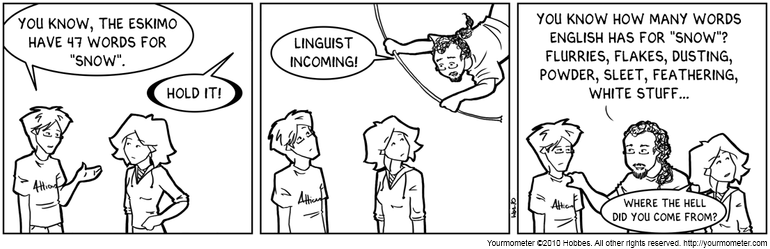 I'll be honest: most linguists do not swing on ropes into the conversations of random bystanders, a habit which, while cool for the scientist involved, would probably get somewhat tiresome for the rest of us before long.
A further point on the subject comes from the column The Straight Dope, which has been "Fighting Ignorance Since 1973 (It's taking longer than we thought)". Writer Cecil Adams points out, "The problem with trying to pin down exactly how many Eskimo words there for snow and/or ice — or for anything, for that matter — is that Eskimo is what's called a "polysynthetic" language, which means you sort of make up words as you go along, by connecting various particles to your basic root word. For example, we may add the suffix -tluk, bad, to kaniktshaq, snow, and come up with kaniktshartluk, bad snow."
This is a problem that plagues anyone attempting to count the words in a given language. We can see a variant in English, which does not have the same polysynthetic properties as Eskimo. Is 'to snow' different from 'snow', 'snows', 'snowing', or 'snowed'? What about 'snowplow'? It's its own word, sure, but it's really just a 'plow for snow'.
(Cecil also mentions that he has been attempting to write a sentence of his own in Eskimo: "When completed, this sentence will proclaim: 'Look at all this freaking snow.' At present it means: 'Observe the snow. It fornicates.'" Lost in translation Cecil, lost in translation.)
Anyway, the gist of the comic and the essay is that although Eskimo dialects do have many words for snow, it is misleading to draw conclusions about their worldview from this fact. "Eskimos have # words for snow!" depicts another culture as strange/foreign based on evidence taken so far out of context that it doesn't even apply.
Yet, although I still have the instinctive need to correct that igloo-thesaurus brigade, I don't find them quite as annoying as I used to-for the simple reason that, however misguided they may be, they are at least thinking about linguistics.
Language is one of the most amazing tools we use in our everyday lives. It is ever-evolving and bizarrely, capable of more nuance than it can describe with its own words. But most people take all this for granted. The grammar, idioms, and slang that we use every day are more intricate than anyone ever imagines. Anything that brings people to contemplate the astonishing power of their own language is a service to humankind.
The Sapir-Whorf hypothesis is the claim that our language directly influences our perception of the world, as well as an idea which could easily fill a blog post of its own, if I didn't suspect you guys were getting bored already. This is at its most basic level what the Eskimo factoid is driving at: "I can't distinguish 47 kinds of snow, can you? Maybe if we spoke Eskimo we would think differently."
Me? I'm not sure I buy the Sapir-Whorf hypothesis. But ultimately, it's just fun to contemplate. Thinking about linguistics helps me appreciate the words I use all the time. And if slandering the Eskimos helps other people do the same, well-it might just be a necessary evil.
-Alison
Sunday, November 14, 2010
If You Catch My Drift

Subscribe to:
Post Comments (Atom)

No comments:
Post a Comment